---
description: See squamous cell skin cancer pictures and know the early warning signs to help you spot this common skin cancer.
title: Squamous Cell Carcinoma Warning Signs and Images
image: https://www.skincancer.org/wp-content/uploads/SCCWarningSigns.jpg
---


[Home](https://www.skincancer.org/) › [Skin Cancer Information](https://www.skincancer.org/skin-cancer-information/) › [Squamous Cell Carcinoma](https://www.skincancer.org/skin-cancer-information/squamous-cell-carcinoma/) › Squamous Cell Carcinoma Warning Signs and Images

Translation: [](https://skincancer.org/international/le-carcinome-epidermoide-cutane/#warning) [](http://skincancer.org/international/das-plattenepithelkarzinom/#warning) [](http://skincancer.org/international/carcinoma-spino-cellulare/#warning) [](https://www.skincancer.org/international/%CE%B1%CE%BA%CE%B1%CE%BD%CE%B8%CE%BF%CE%BA%CF%85%CF%84%CF%84%CE%B1%CF%81%CE%B9%CE%BA%CE%BF-%CE%BA%CE%B1%CF%81%CE%BA%CE%B9%CE%BD%CF%89%CE%BC%CE%B1/) [](https://www.skincancer.org/international/carcinoma-celulas-escamosas/)

[En Español](https://cancerdepiel.org/cancer-de-piel/carcinoma-de-celulas-escamosas#imagenes)

# Squamous Cell Carcinoma  
Warning Signs & Pictures

## What Does Squamous Cell Carcinoma Look Like?

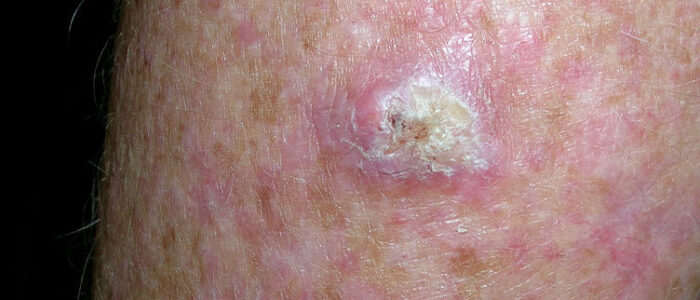
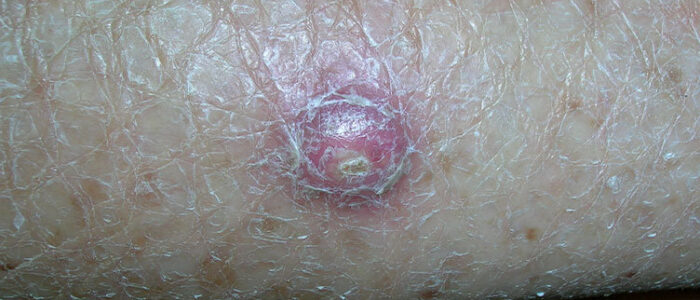
It’s important to know what squamous cell carcinoma (SCC) looks like. Because, when caught promptly, almost all SCCs of the skin can be successfully treated. But when they become more advanced, these skin cancers can become dangerous.

That’s why it’s important to be on the lookout for any **SCC warning signs**, including **new,** **changing** or **unusual** skin growths.

* [How to spot an SCC](#spot)
* [SCC images](#images)
* [What you can do](#do)
* [Rare skin cancers](https://www.skincancer.org/skin-cancer-information/rare-skin-cancers/)
* [Get the Skin Cancer Awareness Toolkit](https://www.skincancer.org/get-involved/skin-cancer-awareness-month/toolkit/)
* [More images](#moreimg)

[Overview ](https://www.skincancer.org/skin-cancer-information/squamous-cell-carcinoma/)

[Risk Factors ](http://www.skincancer.org/skin-cancer-information/squamous-cell-carcinoma/scc-causes-and-risk-factors/ "Squamous Cell Carcinoma Risk Factors")

[Treatment ](http://www.skincancer.org/skin-cancer-information/squamous-cell-carcinoma/scc-treatment-options/ "Squamous Cell Carcinoma Treatment")

[Advanced SCC Treatment ](http://www.skincancer.org/skin-cancer-information/squamous-cell-carcinoma/advanced-scc/ "Advanced Squamous Cell Carcinoma Treatment")

### How to spot an SCC

SCC of the skin can develop anywhere on the body but is most often found on exposed areas exposed to [ultraviolet (UV) radiation](http://skincancer.org/risk-factors/uv-radiation/) like the face, lips, ears, scalp, shoulders, neck, back of the hands and forearms. SCCs can develop in scars, skin sores and other areas of skin injury. The skin around them typically shows signs of sun damage such as wrinkling, pigment changes and loss of elasticity.

SCCs can appear as thick, rough, scaly patches that may crust or bleed. They can also resemble warts, or open sores that don’t completely heal. Sometimes SCCs show up as growths that are raised at the edges with a lower area in the center that may bleed or itch.

### SCC images

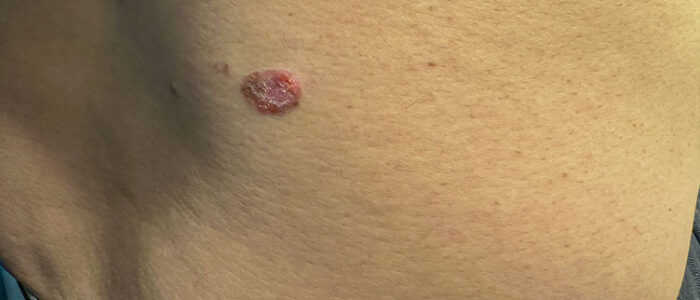
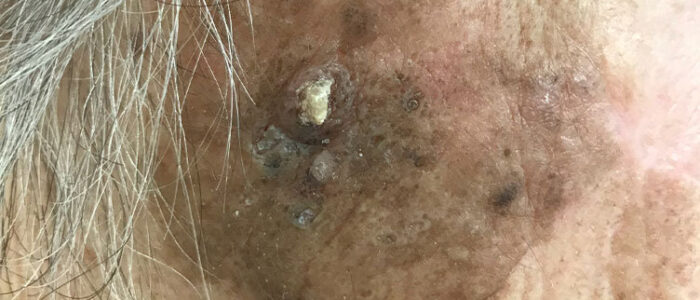
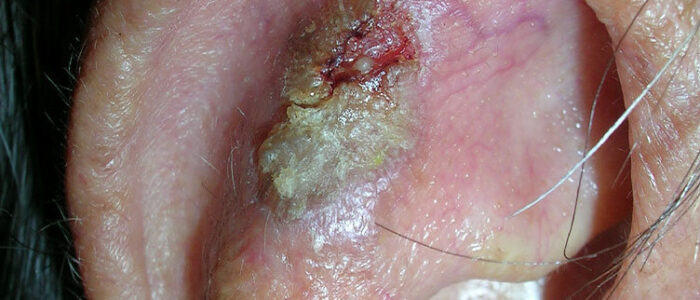
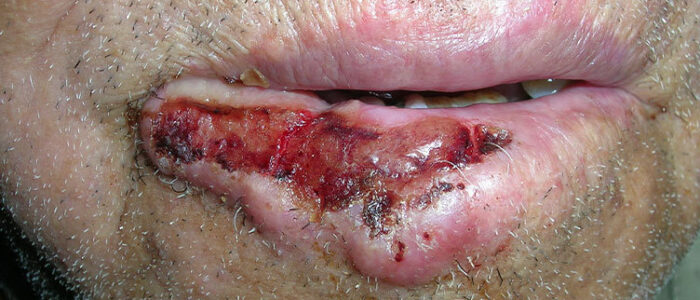
The following photos show SCC warning signs to watch for. To view more photos, visit our [Skin Cancer Pictures](https://www.skincancer.org/skin-cancer-information/skin-cancer-pictures/#scc) page.

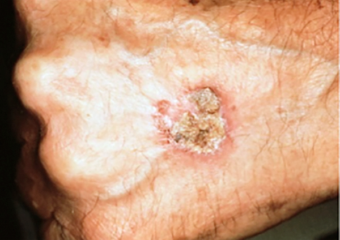
![Patch on man hand squamous cell carcinoma]()

A persistent, scaly red patch with irregular borders that sometimes crusts or bleeds.

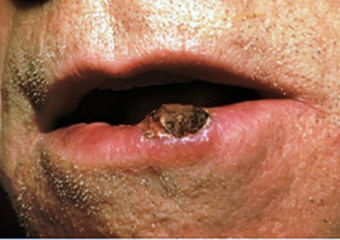
![squamous cell carcinoma on lip]()

An elevated growth with a central depression that occasionally bleeds. It may rapidly increase in size.

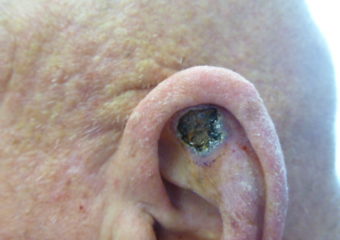
![Picture open sore man left ear]()

An open sore that bleeds or crusts and persists for weeks.

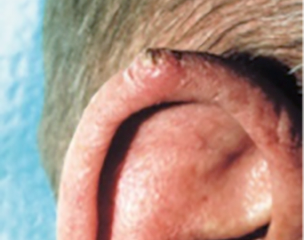
![wart-like growth squamous cell carcinoma on ear]()

A wart-like growth that crusts and occasionally bleeds.

SCCs can also look different from the descriptions above. If you notice anything unusual, such as a sore that fails to heal, or a new spot, make an appointment with your dermatologist.

_Please note: Since not all SCCs have the same appearance, these photos serve as a general reference for what they can look like._ 

### What you can do

**Examine yourself head to toe once a month:** Keep an eye out for new or changing lesions that grow, bleed, or do not heal. Learn how to [check your skin here](http://skincancer.org/early-detection/self-exams/).

**When in doubt, check it out.** Follow your instincts and visit your doctor if you see a spot that just doesn’t seem right.

**See your dermatologist** for a [professional skin exam](http://skincancer.org/early-detection/annual-exams/) every year even if you don’t see anything suspicious. These specialists are skilled at identifying and treating abnormal skin growths that may be undetectable to the untrained eye and can check areas of your body that are difficult for you to see yourself.

**Follow up regularly:** Especially if you’ve already had either SCC or basal cell carcinoma (BCC), melanoma or precancers like actinic keratosis, be sure to see your dermatologist for a skin exam at recommended intervals.

**Practice sun safety:** Making [daily sun protection](http://skincancer.org/skin-cancer-prevention/sun-protection/) a part of your lifestyle is the single most effective way to reduce your risk of developing skin cancer.

### More SCC Images

* ![]()  
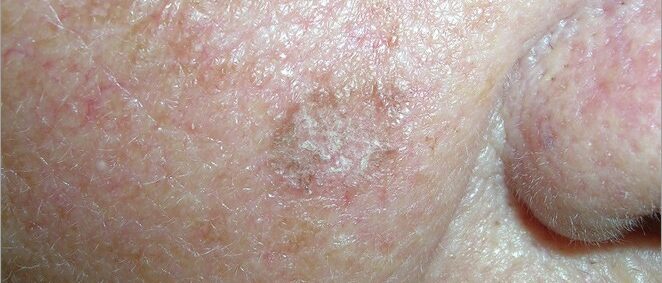
Squamous cell carcinoma, scaly patch on cheek  
Photo credit: Richard P. Usatine, MD.
* ![Squamous cell carcinoma on light skin]()  
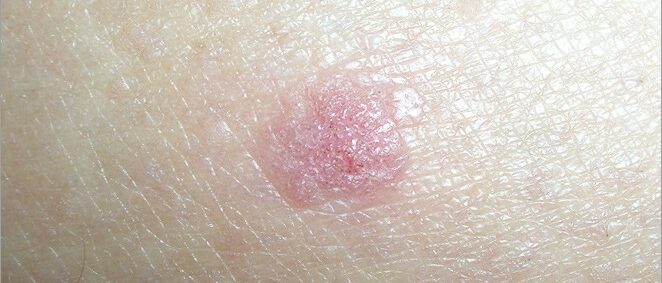
Squamous cell carcinoma on light skin  
Photo credit: Richard P. Usatine, MD.
* ![]()  
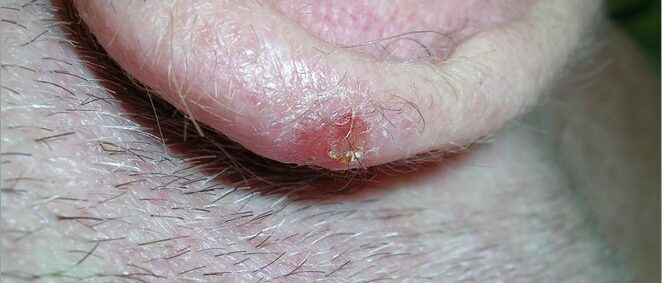
Squamous cell carcinoma on ear  
Photo credit: Richard P. Usatine, MD.
* ![Squamous cell carcinoma on forearm of man with darker skin tone]()  
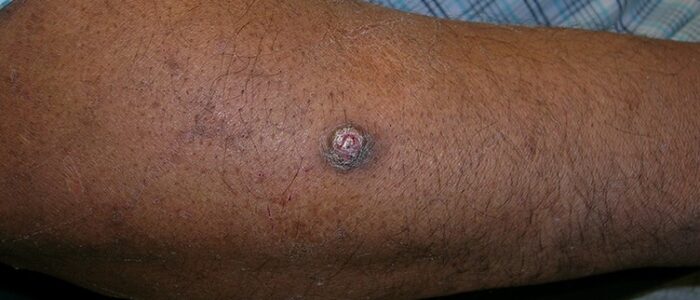
Squamous cell carcinoma on forearm of man with darker skin tone  
Photo credit: Richard P. Usatine, MD.
* ![Raised, reddish squamous cell carcinoma]()  
Raised, reddish squamous cell carcinoma  
Photo credit: Richard P. Usatine, MD.
* ![]()  
Squamous cell carcinoma near hairline  
Photo credit: Richard P. Usatine, MD.
* ![]()  
Large, crusty squamous cell carcinoma on ear  
Photo credit: Richard P. Usatine, MD.
* ![]()  
Large squamous cell carcinoma on lip  
Photo credit: Richard P. Usatine, MD.
* ![]()  
Squamous cell carcinoma beside toenail  
Photo credit: Richard P. Usatine, MD.
* ![]()  
Large, crusty squamous cell carcinoma  
Photo credit: Richard P. Usatine, MD.
* ![]()  
Raised, red, scaly squamous cell carcinoma  
Photo credit: Richard P. Usatine, MD.
* ![Large pigmented squamous cell carcinoma]()  
Large pigmented squamous cell carcinoma  
Photo credit: Richard P. Usatine, MD.

_**Reviewed by**:_ 
_Elizabeth K. Hale, MD_ 
_C. William Hanke, MD_

_**Last updated:** February 2022_

This section made possible with support from

[ ](https://www.regeneron.com/)  
[ ](https://mysccskincancer.com/)  
[ ](https://sunpharma.com/)

## Sun & Skin News

[](https://www.skincancer.org/blog/celebrities-skin-cancer/ "Celebrities and Skin Cancer – They’re Just Like Us")![Hollywood sign]()

[This Is Skin Cancer](https://www.skincancer.org/blog/category/true-stories/)

### [Celebrities and Skin Cancer – They’re Just Like Us](https://www.skincancer.org/blog/celebrities-skin-cancer/ "Celebrities and Skin Cancer – They’re Just Like Us")

[](https://www.skincancer.org/blog/hiding-in-plain-sight-nypd-veteran-uncovers-clues-for-detecting-skin-cancer/ "Hiding in Plain Sight: NYPD Veteran Uncovers Clues for Detecting Skin Cancer ")![Manhattan skyline on a sunny day Empire State Building on the right, New York, United States]()

[This Is Skin Cancer](https://www.skincancer.org/blog/category/true-stories/)

### [Hiding in Plain Sight: NYPD Veteran Uncovers Clues for Detecting Skin Cancer ](https://www.skincancer.org/blog/hiding-in-plain-sight-nypd-veteran-uncovers-clues-for-detecting-skin-cancer/ "Hiding in Plain Sight: NYPD Veteran Uncovers Clues for Detecting Skin Cancer ")

[](https://www.skincancer.org/blog/back-basics-understanding-worlds-common-cancer/ "Back to Basics: Understanding the World’s Most Common Cancer")![skin-cancer-basics]()

[Skin Cancer Awareness Month](https://www.skincancer.org/blog/category/skin-cancer-awareness-month/)

[Skin Cancer Information](https://www.skincancer.org/blog/category/skin-cancer-information/)

### [Back to Basics: Understanding the World’s Most Common Cancer](https://www.skincancer.org/blog/back-basics-understanding-worlds-common-cancer/ "Back to Basics: Understanding the World’s Most Common Cancer")

Last updated: April 2026 

[ Make a Donation ](https://give.skincancer.org/SCFDonate) 

* [Prevention▼](https://www.skincancer.org/skin-cancer-prevention/)
  * [Skin Cancer Prevention](https://www.skincancer.org/skin-cancer-prevention/)
  * [Recommended Products](https://www.skincancer.org/recommended-products/)
  * [Sun Protection▼](https://www.skincancer.org/skin-cancer-prevention/sun-protection/)
    * [Sunscreen](https://www.skincancer.org/skin-cancer-prevention/sun-protection/sunscreen/)
    * [Eye Protection](https://www.skincancer.org/skin-cancer-prevention/sun-protection/eye-protection/)
    * [Sun Protective Clothing](https://www.skincancer.org/skin-cancer-prevention/sun-protection/sun-protective-clothing/)
    * [UV Window Film & Tint](https://www.skincancer.org/skin-cancer-prevention/sun-protection/uv-window-film/)
    * [Vitamin D](https://www.skincancer.org/skin-cancer-prevention/sun-protection/vitamin-d/)
  * [Seal of Recommendation](https://www.skincancer.org/skin-cancer-prevention/seal-of-recommendation-archived/)
* [Skin Cancer Information▼](https://www.skincancer.org/skin-cancer-information/)
  * [Skin Cancer Information](https://www.skincancer.org/skin-cancer-information/)
  * [Skin Cancer Facts & Statistics](https://www.skincancer.org/skin-cancer-information/skin-cancer-facts/)
  * [Newly Diagnosed with Skin Cancer](https://www.skincancer.org/skin-cancer-information/newly-diagnosed-with-skin-cancer/)
  * [Skin Cancer Pictures | What Does Skin Cancer Look Like?](https://www.skincancer.org/skin-cancer-information/skin-cancer-pictures/)
  * [Skin Cancer in Skin of Color](https://www.skincancer.org/skin-cancer-information/skin-cancer-skin-of-color/)
  * [Actinic Keratosis▼](https://www.skincancer.org/skin-cancer-information/actinic-keratosis/)
    * [Actinic Keratosis Risk Factors](https://www.skincancer.org/skin-cancer-information/actinic-keratosis/causes-and-risk-factors/)
    * [Actinic Keratosis Warning Signs and Images](https://www.skincancer.org/skin-cancer-information/actinic-keratosis/actinic-keratosis-warning-signs-and-images/)
    * [Actinic Keratosis Treatment](https://www.skincancer.org/skin-cancer-information/actinic-keratosis/actinic-keratosis-treatment-options/)
  * [Basal Cell Carcinoma▼](https://www.skincancer.org/skin-cancer-information/basal-cell-carcinoma/)
    * [Basal Cell Carcinoma Risk Factors](https://www.skincancer.org/skin-cancer-information/basal-cell-carcinoma/bcc-causes-and-risk-factors/)
    * [Basal Cell Carcinoma Warning Signs and Images](https://www.skincancer.org/skin-cancer-information/basal-cell-carcinoma/bcc-warning-signs-images/)
    * [Basal Cell Carcinoma Treatment](https://www.skincancer.org/skin-cancer-information/basal-cell-carcinoma/bcc-treatment-options/)
  * [Melanoma▼](https://www.skincancer.org/skin-cancer-information/melanoma/)
    * [Melanoma Risk Factors](https://www.skincancer.org/skin-cancer-information/melanoma/melanoma-causes-and-risk-factors/)
    * [Melanoma Warning Signs and Images](https://www.skincancer.org/skin-cancer-information/melanoma/melanoma-warning-signs-and-images/)
    * [Melanoma Stages](https://www.skincancer.org/skin-cancer-information/melanoma/the-stages-of-melanoma/)
    * [Melanoma Treatment](https://www.skincancer.org/skin-cancer-information/melanoma/melanoma-treatments/)
  * [Merkel Cell Carcinoma▼](https://www.skincancer.org/skin-cancer-information/merkel-cell-carcinoma/)
    * [Merkel Cell Carcinoma Risk Factors](https://www.skincancer.org/skin-cancer-information/merkel-cell-carcinoma/mcc-risk-factors/)
    * [Merkel Cell Carcinoma Warning Signs and Images](https://www.skincancer.org/skin-cancer-information/merkel-cell-carcinoma/mcc-warning-signs/)
    * [Merkel Cell Carcinoma Stages](https://www.skincancer.org/skin-cancer-information/merkel-cell-carcinoma/mcc-stages/)
    * [Merkel Cell Carcinoma Treatment](https://www.skincancer.org/skin-cancer-information/merkel-cell-carcinoma/mcc-treatment/)
    * [Merkel Cell Carcinoma Patient Support Center](https://www.skincancer.org/skin-cancer-information/merkel-cell-carcinoma/mcc-patient-support/)
  * [Squamous Cell Carcinoma▼](https://www.skincancer.org/skin-cancer-information/squamous-cell-carcinoma/)
    * [Squamous Cell Carcinoma Risk Factors](https://www.skincancer.org/skin-cancer-information/squamous-cell-carcinoma/scc-causes-and-risk-factors/)
    * [Squamous Cell Carcinoma Warning Signs and Images](https://www.skincancer.org/skin-cancer-information/squamous-cell-carcinoma/scc-warning-signs-and-images/)
    * [Squamous Cell Carcinoma Treatment](https://www.skincancer.org/skin-cancer-information/squamous-cell-carcinoma/scc-treatment-options/)
    * [Advanced Squamous Cell Carcinoma Treatment](https://www.skincancer.org/skin-cancer-information/squamous-cell-carcinoma/advanced-scc/)
  * [Rare Skin Cancers](https://www.skincancer.org/skin-cancer-information/rare-skin-cancers/)
* [Risk Factors▼](https://www.skincancer.org/risk-factors/)
  * [Skin Cancer Myths & Misinformation](https://www.skincancer.org/risk-factors/skin-cancer-myths-misinformation/)
  * [Working Outdoors](https://www.skincancer.org/risk-factors/working-outdoors/)
  * [Risk Factors](https://www.skincancer.org/risk-factors/)
  * [Tanning](https://www.skincancer.org/risk-factors/tanning/)
  * [Sunburn](https://www.skincancer.org/risk-factors/sunburn/)
  * [Atypical Moles](https://www.skincancer.org/risk-factors/atypical-moles/)
  * [UV Radiation](https://www.skincancer.org/risk-factors/uv-radiation/)
  * [Photosensitivity](https://www.skincancer.org/risk-factors/photosensitivity/)
  * [Skin Type](https://www.skincancer.org/risk-factors/skin-type/)
* [Early Detection▼](https://www.skincancer.org/early-detection/)
  * [Early Detection](https://www.skincancer.org/early-detection/)
  * [Self-Exams](https://www.skincancer.org/early-detection/self-exams/)
  * [Annual Exams](https://www.skincancer.org/early-detection/annual-exams/)
  * [Find a Dermatologist](https://www.skincancer.org/treatment-resources/find-a-dermatologist/)
  * [Destination Healthy Skin▼](https://www.skincancer.org/early-detection/destination-healthy-skin/)
    * [Schedule](https://www.skincancer.org/early-detection/destination-healthy-skin/schedule/)
    * [Physician Volunteers](https://www.skincancer.org/early-detection/destination-healthy-skin/physician-volunteers/)
  * [The Big See](https://www.skincancer.org/early-detection/the-big-see/)
* [Treatment & Resources▼](https://www.skincancer.org/treatment-resources/)
  * [Treatment & Resources](https://www.skincancer.org/treatment-resources/)
  * [Mohs Surgery](https://www.skincancer.org/treatment-resources/mohs-surgery/)
  * [Treatment Glossary](https://www.skincancer.org/treatment-resources/treatment-glossary/)
  * [Find a Dermatologist](https://www.skincancer.org/treatment-resources/find-a-dermatologist/)
  * [Support Resources▼](https://www.skincancer.org/treatment-resources/support-resources/)
    * [Robins Nest](https://www.skincancer.org/treatment-resources/support-resources/robins-nest/)
    * [COVID-19 and You](https://www.skincancer.org/treatment-resources/support-resources/robins-nest/covid-19-and-you/)
* [Blog](https://www.skincancer.org/skin-cancer-foundation-blog/)
* [Get Involved▼](https://www.skincancer.org/get-involved/)
  * [Get Involved](https://www.skincancer.org/get-involved/donate/)
  * [Your Donation at Work](https://www.skincancer.org/get-involved/your-donation-at-work/)
  * [Connect With Us](https://www.skincancer.org/get-involved/connect-with-us/)
  * [Sign Up for Newsletter](https://www.skincancer.org/newsletter-sign-up/)
  * [SAFE Sunscreen Standards Act](https://www.skincancer.org/get-involved/safe-sunscreen-standards-act/)
  * [Petition Update](https://www.skincancer.org/get-involved/sign-the-petition/)
  * [Skin Cancer Awareness Toolkit](https://www.skincancer.org/get-involved/skin-cancer-awareness-month/toolkit/)
  * [Skin Cancer Awareness Month](https://www.skincancer.org/get-involved/skin-cancer-awareness-month/)
  * [Share Your Story](https://www.skincancer.org/get-involved/share-your-story/)
  * [Create a Fundraiser](https://www.skincancer.org/get-involved/become-a-champion/)
  * [Champions for Change Gala](https://www.skincancer.org/get-involved/gala/)
  * [For Medical Providers](https://provider.skincancer.org/)
* [About Us▼](https://www.skincancer.org/about-us/)
  * [About Us](https://www.skincancer.org/about-us/)
  * [Who We Are](https://www.skincancer.org/about-us/who-we-are/)
  * [What We Do](https://www.skincancer.org/about-us/what-we-do/)
  * [Web Store](https://store.skincancer.org/)
  * [Research Grants](https://www.skincancer.org/about-us/research-grants/)
  * [Press Room](https://www.skincancer.org/media-and-press/)
  * [Publications](https://www.skincancer.org/about-us/publications/)
  * [Corporate Council](https://www.skincancer.org/about-us/who-we-are/corporate-council/)
  * [Education Programs](https://www.skincancer.org/about-us/education-programs/)
  * [Contact Us](https://www.skincancer.org/about-us/contact-us/)

  
[Find a Dermatologist](https://www.skincancer.org/treatment-resources/find-a-dermatologist/)  
  
[Recommended Products](https://www.skincancer.org/recommended-products/)   
  

```json
{"@context":"https:\/\/schema.org","@graph":[{"@type":"WebPage","@id":"https:\/\/www.skincancer.org\/skin-cancer-information\/squamous-cell-carcinoma\/scc-warning-signs-and-images\/","url":"https:\/\/www.skincancer.org\/skin-cancer-information\/squamous-cell-carcinoma\/scc-warning-signs-and-images\/","name":"Squamous Cell Carcinoma Warning Signs and Images - The Skin Cancer Foundation","isPartOf":{"@id":"https:\/\/www.skincancer.org\/#website"},"primaryImageOfPage":{"@id":"https:\/\/www.skincancer.org\/skin-cancer-information\/squamous-cell-carcinoma\/scc-warning-signs-and-images\/#primaryimage"},"image":{"@id":"https:\/\/www.skincancer.org\/skin-cancer-information\/squamous-cell-carcinoma\/scc-warning-signs-and-images\/#primaryimage"},"thumbnailUrl":"https:\/\/www.skincancer.org\/wp-content\/uploads\/SCCWarningSigns.jpg","datePublished":"2019-06-03T17:00:27+00:00","dateModified":"2026-04-09T13:45:43+00:00","description":"See squamous cell skin cancer pictures and know the early warning signs to help you spot this common skin cancer.","breadcrumb":{"@id":"https:\/\/www.skincancer.org\/skin-cancer-information\/squamous-cell-carcinoma\/scc-warning-signs-and-images\/#breadcrumb"},"inLanguage":"en-US","potentialAction":[{"@type":"ReadAction","target":["https:\/\/www.skincancer.org\/skin-cancer-information\/squamous-cell-carcinoma\/scc-warning-signs-and-images\/"]}]},{"@type":"ImageObject","inLanguage":"en-US","@id":"https:\/\/www.skincancer.org\/skin-cancer-information\/squamous-cell-carcinoma\/scc-warning-signs-and-images\/#primaryimage","url":"https:\/\/www.skincancer.org\/wp-content\/uploads\/SCCWarningSigns.jpg","contentUrl":"https:\/\/www.skincancer.org\/wp-content\/uploads\/SCCWarningSigns.jpg","width":1920,"height":1008,"caption":"Picture of SCC on a man's lower lip"},{"@type":"BreadcrumbList","@id":"https:\/\/www.skincancer.org\/skin-cancer-information\/squamous-cell-carcinoma\/scc-warning-signs-and-images\/#breadcrumb","itemListElement":[{"@type":"ListItem","position":1,"name":"Home","item":"https:\/\/www.skincancer.org\/"},{"@type":"ListItem","position":2,"name":"Skin Cancer Information","item":"https:\/\/www.skincancer.org\/skin-cancer-information\/"},{"@type":"ListItem","position":3,"name":"Squamous Cell Carcinoma","item":"https:\/\/www.skincancer.org\/skin-cancer-information\/squamous-cell-carcinoma\/"},{"@type":"ListItem","position":4,"name":"Squamous Cell Carcinoma Warning Signs and Images"}]},{"@type":"WebSite","@id":"https:\/\/www.skincancer.org\/#website","url":"https:\/\/www.skincancer.org\/","name":"The Skin Cancer Foundation","description":"Education, prevention, early detection, and treatment of skin cancer","publisher":{"@id":"https:\/\/www.skincancer.org\/#organization"},"potentialAction":[{"@type":"SearchAction","target":{"@type":"EntryPoint","urlTemplate":"https:\/\/www.skincancer.org\/?s={search_term_string}"},"query-input":{"@type":"PropertyValueSpecification","valueRequired":true,"valueName":"search_term_string"}}],"inLanguage":"en-US"},{"@type":"Organization","@id":"https:\/\/www.skincancer.org\/#organization","name":"The Skin Cancer Foundation","url":"https:\/\/www.skincancer.org\/","logo":{"@type":"ImageObject","inLanguage":"en-US","@id":"https:\/\/www.skincancer.org\/#\/schema\/logo\/image\/","url":"https:\/\/www.skincancer.org\/wp-content\/uploads\/SCF-Logo-2025-4C.png","contentUrl":"https:\/\/www.skincancer.org\/wp-content\/uploads\/SCF-Logo-2025-4C.png","width":1199,"height":1254,"caption":"The Skin Cancer Foundation"},"image":{"@id":"https:\/\/www.skincancer.org\/#\/schema\/logo\/image\/"},"sameAs":["https:\/\/www.facebook.com\/skincancerfoundation","https:\/\/x.com\/skincancerorg","https:\/\/www.instagram.com\/skincancerorg\/","https:\/\/www.linkedin.com\/company\/the-skin-cancer-foundation\/","https:\/\/www.pinterest.com\/skincancer\/","https:\/\/www.youtube.com\/user\/SkinCancerFoundation","https:\/\/en.wikipedia.org\/wiki\/Skin_Cancer_Foundation","https:\/\/www.tiktok.com\/@skincancerorg"],"description":"The Skin Cancer Foundation saves and improves lives. We empower people to take a proactive approach to daily sun protection and the early detection and treatment of skin cancer.","email":"info@skincancer.org","telephone":"(212) 725-5176","legalName":"The Skin Cancer Foundation"}]}
{
  "@context": "https://schema.org",
  "@type": "FAQPage",
  "mainEntity": [
    {
      "@type": "Question",
      "name": "What are the warning signs of squamous cell carcinoma?",
      "acceptedAnswer": {
        "@type": "Answer",
        "text": "Squamous cell carcinoma (SCC) warning signs include four main presentations to watch for: (1) A persistent, scaly red patch with irregular borders that sometimes crusts or bleeds. (2) An elevated growth with a central depression that occasionally bleeds and may rapidly increase in size. (3) An open sore that bleeds or crusts and persists for weeks without healing. (4) A wart-like growth that crusts and occasionally bleeds. SCCs can also appear as thick, rough, or scaly patches that may crust or bleed, and sometimes show up as growths that are raised at the edges with a lower area in the center that may bleed or itch. The skin surrounding an SCC typically shows signs of sun damage such as wrinkling, pigment changes, and loss of elasticity. If you notice anything new, changing, or unusual on your skin — especially a sore that fails to heal — make an appointment with your dermatologist promptly."
      }
    },
    {
      "@type": "Question",
      "name": "Where on the body does squamous cell carcinoma most commonly appear?",
      "acceptedAnswer": {
        "@type": "Answer",
        "text": "SCC of the skin can develop anywhere on the body but is most often found on areas exposed to UV radiation, including the face, lips, ears, scalp, shoulders, neck, back of the hands, and forearms. SCCs can also develop in scars, skin sores, and other areas of skin injury. The surrounding skin typically shows signs of chronic sun damage such as wrinkling, pigment changes, and loss of elasticity. SCC on the lips is a particular location to watch for, as it can rapidly increase in size and carries a higher risk of spreading."
      }
    },
    {
      "@type": "Question",
      "name": "Can squamous cell carcinoma look like a wart?",
      "acceptedAnswer": {
        "@type": "Answer",
        "text": "Yes. One of the warning signs of SCC is a wart-like growth that crusts and occasionally bleeds. SCCs can also resemble warts more generally, appearing as rough, thickened growths on the skin. This resemblance to a benign wart is one reason SCCs can be dismissed or go unrecognized, leading to delayed treatment. Any wart-like growth that is new, changing, crusting, bleeding, or not resolving should be evaluated by a dermatologist — do not assume it is benign without a professional examination."
      }
    },
    {
      "@type": "Question",
      "name": "What does squamous cell carcinoma look like on different skin tones?",
      "acceptedAnswer": {
        "@type": "Answer",
        "text": "SCCs look different from person to person and can vary based on skin tone. On lighter skin, SCCs commonly appear as scaly red patches, pink or red raised growths, or open sores. On darker skin tones, SCCs may appear pigmented — brown or darker in color — and can be harder to recognize against the surrounding skin tone. SCCs in people of color are more likely to arise in areas of previous skin damage, scarring, or inflammation rather than on sun-exposed areas. Regardless of skin tone, any persistent, new, or changing skin growth — especially one that does not heal, bleeds, or crusts — should be evaluated by a dermatologist."
      }
    },
    {
      "@type": "Question",
      "name": "What should I do if I notice a warning sign of squamous cell carcinoma?",
      "acceptedAnswer": {
        "@type": "Answer",
        "text": "Do not wait. When caught promptly, almost all SCCs of the skin can be successfully treated. If you notice anything unusual — such as a sore that fails to heal, a new or changing spot, or a growth that bleeds or crusts — make an appointment with your dermatologist as soon as possible. Perform a thorough head-to-toe skin self-exam monthly, watching for new or changing lesions. See a dermatologist at least once a year for a professional full-body skin exam, even if you do not see anything suspicious, as specialists can identify abnormal growths not visible to the untrained eye. If you have previously had SCC, basal cell carcinoma, melanoma, or a precancer such as actinic keratosis, follow your dermatologist's recommended screening intervals closely."
      }
    }
  ]
}
```