
Translation: 


Squamous Cell Carcinoma Overview
The Second Most Common Skin Cancer
What is squamous cell carcinoma? Squamous cell carcinoma (SCC) of the skin is the second most common form of skin cancer, characterized by abnormal, accelerated growth of squamous cells. When caught early, most SCCs are curable.
SCC of the skin is also known as cutaneous squamous cell carcinoma (cSCC). Adding the word “cutaneous” identifies it as a skin cancer and differentiates it from squamous cell cancers that can arise inside the body, in places like the mouth, throat or lungs.
What are squamous cells?
One of three main types of cells in the top layer of the skin (the epidermis), squamous cells are flat cells located near the surface of the skin that shed continuously as new ones form.
Squamous cell carcinoma occurs when DNA damage from exposure to ultraviolet radiation or other damaging agents trigger abnormal changes in the squamous cells.
What does SCC look like?
Squamous cell carcinomas most commonly arise in sun-exposed areas of the body. They can appear as
- Scaly red patches
- Open sores
- Rough, thickened or wart-like skin
- Raised growths with a central depression
At times, SCCs may crust over, itch or bleed. Bowen’s disease is a type of early stage SCC localized in the outermost layer of skin (in situ).
SCCs can also occur in other areas of the body, including the genitals.
SCCs look different on everyone. For more images, visit our Skin Cancer Pictures page. To learn more about SCC signs, symptoms and early detection strategies, go to our SCC Warning Signs page.
Please note: Since not all SCCs have the same appearance, these photos serve as general reference for what they can look like. If you see something new, changing or unusual on your skin, schedule an appointment with your dermatologist.
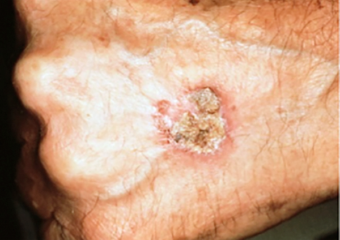
A persistent, scaly red patch with irregular borders that sometimes crusts or bleeds.
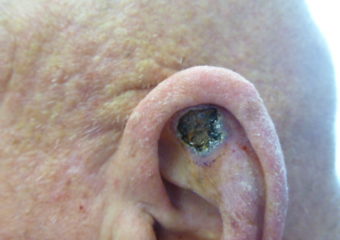
An open sore that bleeds or crusts and persists for weeks.
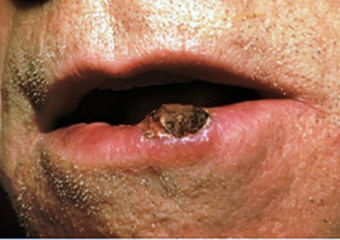 An elevated growth with a central depression that occasionally bleeds. It may rapidly increase in size.
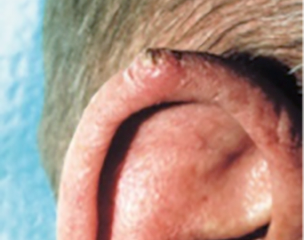
A wart-like growth that crusts and occasionally bleeds.
How dangerous is SCC?
While the majority of squamous cell carcinoma cases can be easily and successfully treated, if allowed to grow, these lesions can become disfiguring, dangerous and even deadly. Untreated SCCs can become invasive, grow into deeper layers of skin and spread to other parts of the body.
Did you know?
1.8 Million
An estimated 1.8 million cases of SCC are diagnosed each year, which translates to about 205 cases diagnosed every hour.

How widespread is SCC?
While SCC is less common than basal cell carcinoma (BCC), the number of reported SCC cases in the U.S. has steadily increased.
- An estimated 1.8 million cases of SCC are diagnosed each year, which translates to about 205 cases diagnosed every hour.
- SCC incidence has increased up to 200 percent in the past three decades.
This section is made possible with support from