
Photos courtesy of: Brinly M.
Brinly was just 23 years old when she popped a little pimple on her upper lip. To her alarm, the lesion began to grow and change, prompting her to see a doctor. After several failed treatments, Brinly saw a dermatologist and got a shocking diagnosis: Her “pimple” was not a pimple at all. It was an invasive squamous cell carcinoma (SCC).
This set Brinly on a frightening journey that opened her eyes about the dangers of skin cancer. Now she’s sharing her story to support young skin cancer warriors and to convince people everywhere that skin cancer is serious.
A big, scary call
For weeks, Brinly’s lesion grew steadily, despite antibiotics, steroids and other treatments prescribed by her doctor. “It had gotten pretty big, a bit bigger than a pea, very noticeable,” she explained. “I knew something was wrong because nothing was working.”
In search of an answer, Brinly saw another doctor, who immediately suspected skin cancer and referred her to a dermatologist. “I remember feeling this wave of relief because finally, someone was taking it seriously,” she said.
In March 2026, her dermatologist confirmed Brinly’s worst fear. “She told me I had invasive squamous cell carcinoma, stage two, meaning that it had extended beyond the deep dermis,” Brinly said. “It was a big, scary call. I could not believe what was happening.”
Fear and isolation
Brinly searched online for someone her age with an SCC diagnosis, to no avail. “I did not see any other 23-year-olds who had skin cancer on their face,” she explained. “Having nobody to reach out to for support made me feel isolated.
“I didn’t realize how scary it was until I had it,” she continued. “It shouldn’t be something that’s talked about lightly; It’s NOT ‘just skin cancer.’ People don’t get how bad it is.”
Her battle scar
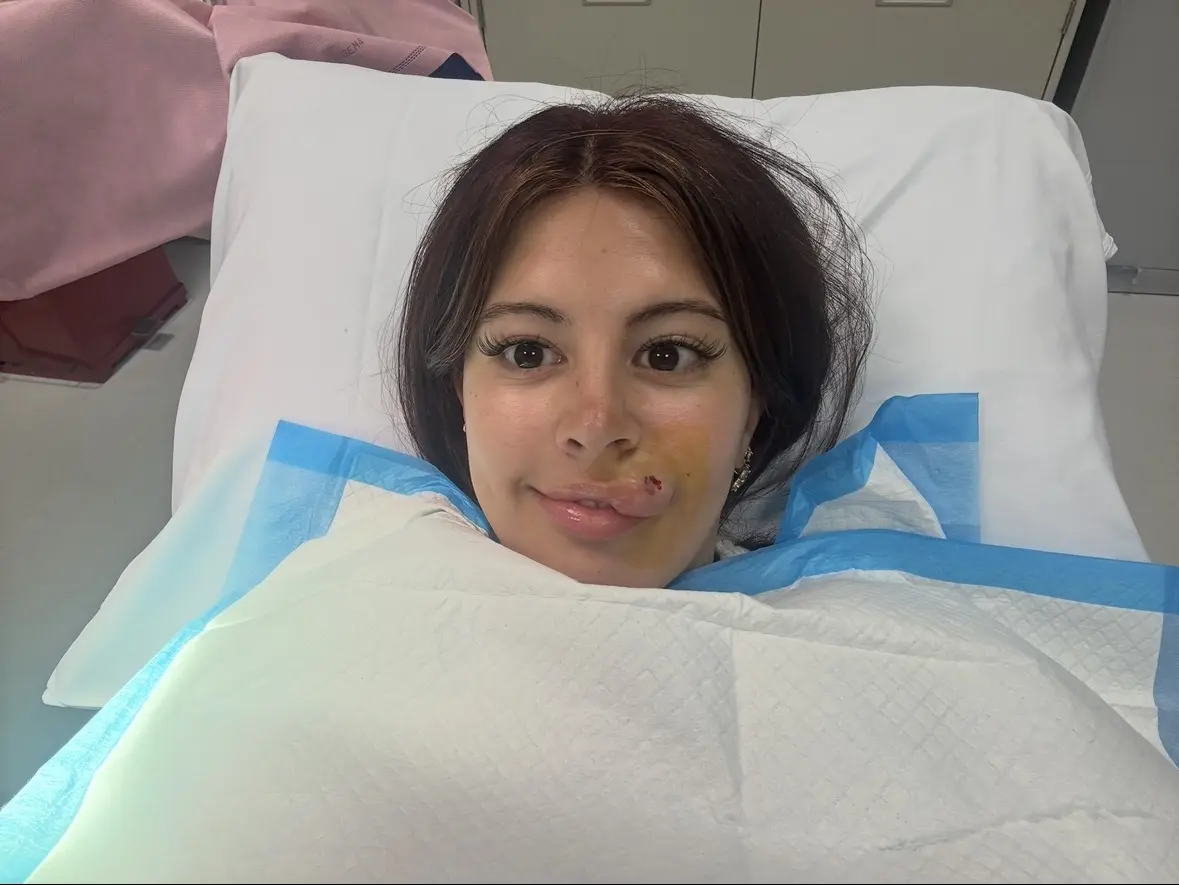
One month after her diagnosis, Brinly underwent Mohs surgery at Massachusetts General Hospital Cancer Center, where she’s employed as a clinical researcher. Because her SCC was located on the vermillion border of her lip, a high-risk area, Brinly was treated by the head and neck cancer team.
“Thankfully, the plastic surgeon on my case found a way to stitch it up along my lip line instead of upwards so I wouldn’t have a flap or big scar on my face,” Brinly explained. “The incision was wide and deep. I see it as a battle scar; a warrior story to tell.”
She says that she feels fortunate that the cancer was treated before it spread to her lymph nodes. ‘Obviously having cancer on your face at 23 is not ideal,” Brinly said. “But if it were anywhere else, I would have taken it less seriously and it could have been so much worse. Because it was on my face, I kept pushing for answers.”
Melanoma diagnosis
Early in her treatment journey, Brinly’s oncologist spoke frankly about her risk for more skin cancers. “I had an invasive SCC at a young age, so the odds of me getting another skin cancer are high,” she said. “But I’m prepared for it.”
Nevertheless, she was surprised at how quickly she’d face a second, more dangerous type of skin cancer. In September 2026, just 6 months after her SCC diagnosis, Brinly learned that she had an early-stage melanoma on her leg, which will be removed with a wide local excision.
“Professional skin checks and monthly self-exams are so important, because skin cancer is really a lifelong surveillance and treatment,” she said. “I’m so lucky that it was detected early, when it’s easiest to treat.”
Brinly gets an ultrasound every 3 months, a professional skin exam every 6 months, does monthly skin checks and is vigilant about protecting her skin and lips from the sun.
Skin cancer can happen to anyone
Her diagnoses have challenged the misconceptions Brinly had about skin cancer and taught her that skin cancer can happen to anyone.
“I did not expect to get skin cancer. I’m not light-skinned. My father is Black and Puerto Rican. I never burn. I wore sunscreen,” Brinly explained. “I don’t have a history of skin cancer in my family. I thought, ‘It’ll never happen to me.’ And then it did.”
Today, sharing her story has become part of Brinly’s healing and purpose. She hopes that someone else her age who receives an unexpected skin cancer diagnosis will find comfort in knowing they aren’t alone.
“My biggest message that I tell all my friends is that cancer is non-discriminatory. It does not care what your skin tone is. It does not care how old you are. It does not care if you don’t get sunburn. Do your skin checks and protect your skin.”
Brinly acknowledges that she has always applied sunscreen to her face, because she did not want to age early, but never put it on my lips. “I’m much better with my sunscreen, I reapply everywhere and I wear a lot of hats now,” she said.
Skin cancer is scary

Photo courtesy of: Brinly M.
“My experience has fundamentally altered the way I understand risk and health and certainty,” she said. “It’s shown me that disease, especially skin cancer, doesn’t always follow expected patterns. The absence of risk factors is not the same as the absence of risk. And more than anything, it has reinforced the importance of listening to my body and trusting my intuition.
“I think that people just aren’t scared enough of skin cancer. Hopefully this sounds a little scarier coming from a younger person. I know that since my diagnosis, a lot of my friends now see a dermatologist. They go do their skin checks, so maybe this will inspire others, too.”