
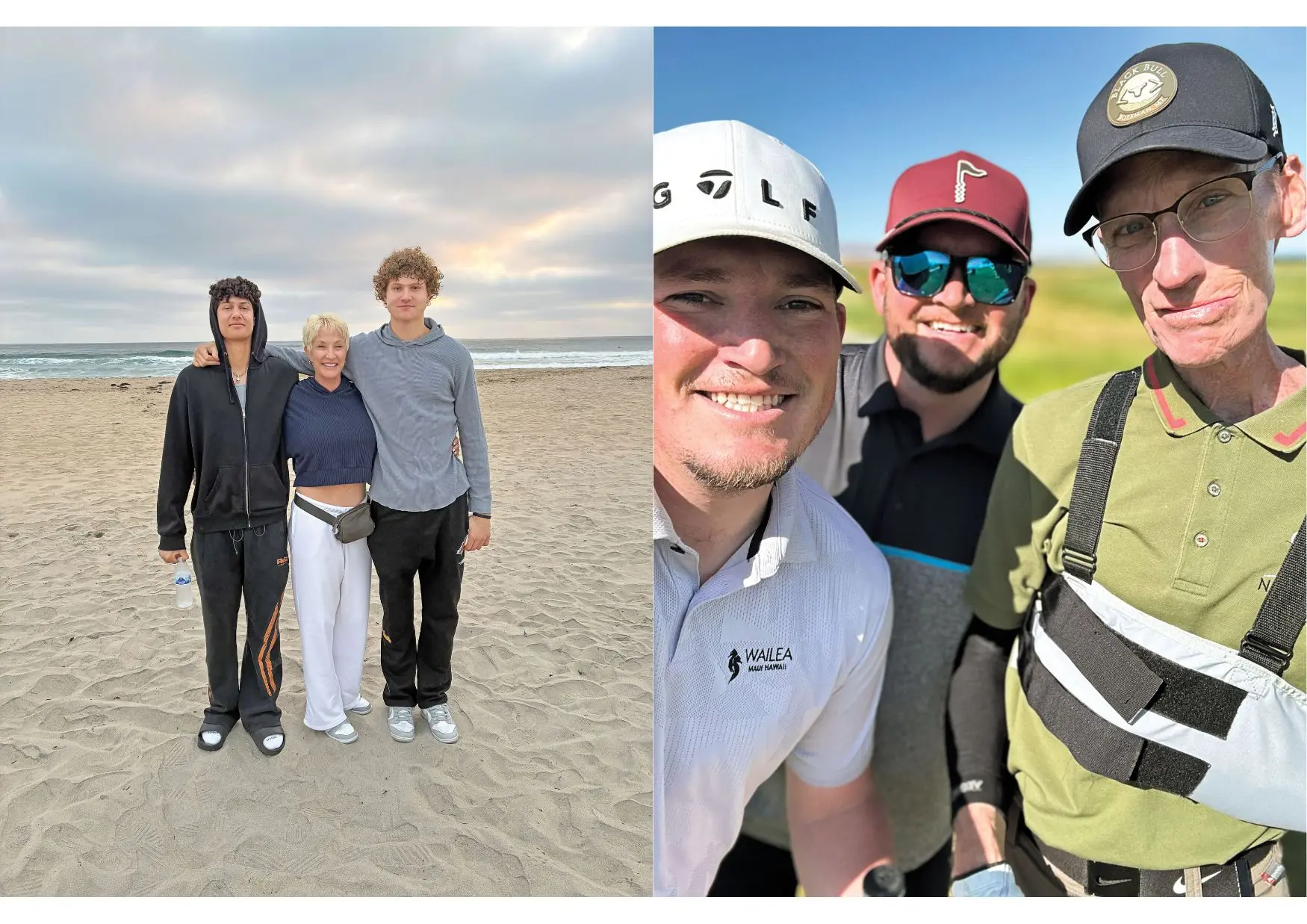
Tena Hughes, above left, a stage IV melanoma survivor who has tried many treatments, loves sun-protected beach time with her two teenage sons. Bob Connors, above right, who survived an aggressive form of squamous cell carcinoma through a clinical trial, practices one-armed golf with his grandkids. Photos courtesy of Tena Hughes and Bob Connors
Despite the many lifesaving breakthroughs in treatment for advanced skin cancer in the past 15 years, not every patient responds to them. That “f” word is often used as medical shorthand to describe an unsuccessful treatment. But is it time to retire it? Patients and doctors share their thoughts on staying hopeful and the value of contributing to clinical research.
By Sarah Elizabeth Richards
If you ask 56-year-old Tena Hughes of Phoenix what it’s like to be a cancer survivor five years after being diagnosed with stage IV melanoma, she will tell you about her summer vacation plans with her teenage sons, in Rocky Point, Mexico, and San Diego, the new job she just started, a book she’s writing and her new healthy smoothie recipes.

Hughes in the hospital with her sister.
Since November of 2025, she’s managing her cancer with encorafenib and binimetinib, a combination that targets a defective, cancer-producing version of a gene called BRAF. Normally, BRAF controls skin cell growth, but the defective version essentially becomes stuck in the “on” position, leading to out-of-control growth of cancer cells. About half of all melanoma patients have this gene mutation.
Now, she says, “There’s no new cancer. I have a metastasis in my brain that’s not growing. I feel better than I have in a long time.” She’s back to her routines of lifting free weights in the gym, hiking up Pinnacle Peak in Scottsdale and watching nightly action movies with the partner she met shortly before being diagnosed. “I talk about living and being healthy and enjoying the day. I’m very aware of how lucky I am,” she says.

Hughes with her niece after lung surgery.
But Tena’s treatment history is filled with failures. First came radiation, followed by brain surgery. She received an anti-PD-1 immune checkpoint inhibitor combination that has saved many lives but that gave her a rare severe immune reaction that put her in the hospital for two and a half months. Then came another surgery to remove four tumors from her brain and the upper lobe of her left lung. That was followed by another kind of immunotherapy known as TIL, for tumor-infiltrating lymphocytes, which became FDA-approved in 2024.
Finally, she participated in two clinical trials in quick succession — one for an immunotherapy combination then called RP1, and the other for a drug called WTX-330 designed to stimulate certain anti-tumor cells. Still, the cancer came back. [Editor’s note: RP1, or vusolimogene oderparepvec-wtpg (Tudriqev), an oncolytic immunotherapy injected directly into the tumor, followed by intravenous nivolumab, was FDA-approved in August 2026. It is for patients with unresectable advanced melanoma whose disease progressed on an anti-PD-1 immune checkpoint inhibitor.]
Shaping Patient Perceptions
What many patients going through cancer treatment don’t realize is that the failures help move the science forward as much as the successes do. Knowledge comes from both. “Many doctors don’t dare say the word ‘failure,’ but it’s actually very descriptive because that’s how it feels,” says Tena. “Before each trial, I did my homework and read about the science, which made sense to me. I had high expectations of my body. But time after time, the results were devastating because they made me feel like the end was near.”
“Failure” is one of the most loaded words in oncology. It’s often used as medical shorthand to describe whether a treatment has worked, yet a growing number of doctors say the term is due for retirement. Not only is the word discouraging to patients who might view it as a reckoning on their cancer, it also doesn’t reflect today’s treatment landscape in which survivors of advanced skin cancer might undergo several lines of treatment.
“It’s a very ingrained terminology, and too often doctors say, ‘You’ve failed immunotherapy,’ or ‘You failed targeted therapy,’” says Vernon Sondak, MD, chair of the Department of Cutaneous Oncology at the H. Lee Moffitt Cancer Center and Research Institute in Tampa, Florida. “I remember the first time a colleague said to me, ‘The patient didn’t fail this treatment. The treatment failed the patient.’ I stopped in my tracks, and I said, ‘You’re right.’ Ever since, I’ve tried to phrase it that way. It’s important for the patient to recognize that it wasn’t something they did wrong.”
Even when doctors avoid the word in direct discussions with patients, some make an effort to avoid it in any communication about their patients’ cases. “For the longest time, we would say, ‘Mrs. Smith has failed CarboTaxol’ [a kind of chemotherapy],” says Michael Wong, MD, PhD, a medical oncologist and skin cancer expert who works as the physician-in-chief at Roswell Park Comprehensive Cancer Center in Buffalo, New York.
“Nowadays, given that patients are able to read their chart directly, you have to soften the language, or at least put it in a way that doesn’t connote that the patient failed,” he says. “It’s much faster for me to communicate to my colleague with medical shorthand, but it’s important to do the longhand because the reality is, the audience has changed.”
For example, he might write: “Mrs. Smith has come in, and her disease had been treated previously with XYZ, and her disease, unfortunately, has shown progression in her last scan and therefore the cancer has now become refractory to A, B and C.”
Dr. Wong is even more intentional about his messaging when speaking directly to patients, and he counsels younger doctors on using hopeful language. “I tell them, ‘Never, ever go and break bad news without a plan. You have to go in with a next step,’” he says. “My patients know me as a Plan B doctor. Even if we’re in the middle of Plan A, I’ve got Plan B in my back pocket.”
Mindset Matters

Connors’ treatment caused him to lose use of his left arm, but he keeps playing!
It’s a mindset shift that makes a strong statement to patients, says Bob Connors, a 63-year-old grandfather, former high-school administrator and business teacher from Bozeman, Montana. He was just 39 when he noticed a dry patch on his cheek and was diagnosed with squamous cell carcinoma. Bob, who also was a football and track coach who ran marathons, underwent multiple rounds of surgery to excise the tumor tissue.
But he had an aggressive form, and within three years, it had spread to his neck. Another surgeon cut out a tumor in a procedure that paralyzed his left vocal cord, followed by two kinds of chemotherapy and 136 radiation treatments. He also lost use of his left arm and developed a dropped foot in his left leg.
Yet after every disappointment, Bob says he appreciated hearing his doctor say bluntly, “We need to try something different.” He said the matter-of-fact approach shaped his expectations, gave him a sense of resilience and reassured his wife about his prognosis. “I always appreciated that we had a game plan in place. I thought, ‘If it works, that’s great. If not, I’ll think about what’s next.’ I believed that failure was the only way to get better. It’s how you grow, learn and adapt.”
So, in December 2014, when his radiologist explained that his cancer had spread and that he should get his affairs in order because he had about six months to live, he felt sucker punched. During the 12 years of treatment since his diagnosis, Bob had always thought there was something more to try.
That evening, his sister-in-law, who worked in fundraising at Portland Providence Medical Center in Oregon, mentioned that her hospital was participating in several oncology clinical trials and suggested he see if there was one that was a good fit.
Four months later, the stars aligned. At the beginning of April 2015, Bob, who lived in Glasgow, Montana, started driving four and a half hours every two weeks to Billings to take a flight to Portland to participate in a phase 1 trial for the anti-PD-1 immune checkpoint inhibitor cemiplimab. At the time, he had a hockey puck-sized tumor in his neck.
Even though he privately had his doubts about his chances for success, he says he tried to project an air of confidence for his wife. “She was way more scared for me,” he says. What inspired him most was a conversation he had on a flight with a woman from Glasgow who mentioned she was traveling to Arizona for cancer treatments who quipped, “If you ain’t flyin’, you’re dyin’.” The message: You had to go find the treatments that would save your life. In other words, you had to keep going.
Two months later, in May 2015, his doctor showed him the results of his CAT scan. “There’s nothing here!” Bob remembers him saying. The tumor had disappeared and has never returned. [Cemiplimab was FDA-approved for advanced SCC in 2018. In 2025, it was also approved for adjuvant (postoperative) treatment of SCC that has a high risk of recurrence after surgery and radiation.]
“It’s been 11 years now, and I really believe I’m cured,” he says. “I still have PTSD every time I see a spot on my face and go to the dermatologist, but it always turns out to be nothing.”
Now, he works as a substitute special education teacher for middle schoolers and has plunged into perfecting what he calls his “one-armed golf game” and played his first adaptive tournament in Minnesota last year. He’s a regular at his grandkids’ basketball games and violin recitals and is planning a road trip with his wife to Coeur d’Alene, Idaho.

Connors with his wife and granddaughters on the course.
“I always think of the phrase, ‘The windshield is much bigger than the rearview mirror for a reason,’” he says. “I’m focused on looking forward.”
No Failure Is a Failure
Dr. Wong, who works as an investigator on several clinical trials, wants to remind patients that even if they don’t receive a benefit from participating in a trial, they’re still standing up for good science. “You’re part of something bigger, and you’re contributing to a large group of knowledge in which things that happen to you or to other people are shared for everyone’s benefit,” he says. “I tell my cancer patients that every single treatment you’ve been on up to this point has been a result of clinical trials. I like to say that clinical trials are a mechanism through which we have established an efficacious, safe and ethical way to bring new therapies to you.”
Tena Hughes says that perspective gave her trial experience meaning — even when they were ultimately unsuccessful. “I’m a huge fan of trials,” she says. “I think they give us hope. If we don’t have data, we can’t move forward. Without human participants, we will never know if the drugs will work. Someone has to go first.”
And it’s important to remember that there are many treatment options. “New therapies are being developed more rapidly than at any time in history,” says Richard Fried, MD, PhD, a board-certified dermatologist and clinical psychologist in Yardley, Pennsylvania.
Today’s treatment journey is long, with many phases. If you don’t respond to one trial, there might be another available soon. Dr. Sondak adds, “We’re living in an era when we’re fortunate enough to have more success than I ever thought possible in my career.”
Five years into her cancer journey, Tena believes her positive attitude counts more than ever. “I have a big, beautiful life and kids who still need their mom, so failure simply isn’t an option,” she says. “I keep thinking that if I keep my mind and body strong, I will stay around long enough for the next treatment that comes around. You have to make a choice to keep trying.”
ABOUT THE AUTHOR
Sarah Elizabeth Richards is a San Diego-based health and science journalist who frequently covers patient stories and oncology. Her writing has appeared in WIRED, Men’s Health, National Geographic, The Atlantic and The New York Times, among other publications.