Sunscreen & Your Skin
Understanding SPF & How it Protects You from Skin Cancer
The big picture: Sunscreen (sometimes called SPF) is an important part of a complete sun protection strategy to safeguard your skin against sun damage and skin cancer. Learn more about how sunscreen protects your skin, what SPF means, what to look for in a sunscreen and how to use it effectively.
When used as directed, sunscreen can:
Decrease your risk of skin cancers and skin precancers. Studies show that regular daily use of SPF 15 sunscreen, when used as directed, can reduce your risk of developing squamous cell carcinoma (SCC) by about 40 percent, and lower your melanoma risk by 50 percent.
Help prevent premature skin aging caused by the sun, including wrinkles, sagging and age spots.
KNOW THE 5 W’S (& H) OF SUNSCREEN
WHO: Everyone under the sun
WHAT: Broad spectrum SPF 30 or higher; SPF 50 or higher for a day outdoors
WHEN: Every day; 30 minutes prior to going outdoors. Reapply every two hours
WHERE: All exposed skin
HOW: One ounce (shot glass full) to entire body for each application
WHY: Reduce your risk of skin damage and skin cancer!

Who should use sunscreen?
The short answer is everyone! Men, women and children over 6 months of age should use sunscreen every day. This includes people who tan easily and those who don’t — remember, your skin is damaged by sun exposure over your lifetime, whether or not you burn.
Babies under the age of 6 months are the only exceptions; their skin is highly sensitive. Stay out of the sun; shade structures and sun-protective clothing are the best ways to safeguard infants.
What type of sunscreen should you use?
With so many choices, how do you pick a sunscreen that’s right for you? The Skin Cancer Foundation believes that the best sunscreen is the one you are most likely to use, so long as it provides safe and effective protection, and is broad spectrum with an SPF 30 or higher. Learn about your options to make an informed choice that best suits your needs. Check out our interactive sun protection product finder to see all the sunscreens that have earned our Seal of Recommendation and find the one that’s right for you. The happier you are with your sunscreen, the more consistently you’ll use it.
Sunscreen ingredients
Sunscreen includes active ingredients that help prevent the sun’s UV radiation from reaching your skin. Here’s how the two types of sunscreen work for you:
Inorganic, or mineral (sometimes still called “physical”) sunscreen ingredients, including titanium dioxide and zinc oxide, stay on top of the skin. They primarily absorb UV radiation and minimally scatter and reflect the radiation.
Organic (sometimes still called “chemical”) sunscreen ingredients, such as bemotrizinol (BEMT) or avobenzone, absorb ultraviolet (UV) radiation, which is then dissipated as heat.
Are sunscreens safe?
While physical sunscreens may be less likely to cause skin irritation than chemical sunscreens, both types have been tested as safe and effective. In fact, many sun protection products available today combine both types of ingredients.
All sunscreen active ingredients (scientifically described as “filters”) are chemically derived. Some people may think of mineral sunscreens as more natural, but they are inorganic mineral compounds. The sunscreens many people call chemical are carbon-based compounds.
What does SPF mean?
SPF stands for Sun Protection Factor. The number measures how much of the sun’s ultraviolet (UV) radiation it takes to redden your skin when using a particular sunscreen (applied generously and evenly, and reapplied after two hours or after sweating or swimming) compared with the amount of UV radiation that reddens the skin without any sunscreen. As the SPF number increases, the protection from sunburn increases. A sunscreen’s SPF number reflects both the amount of UVB and UVA protection it provides.
What level of SPF do I need? If you’re inside most of the day with just short intervals in the sun, you can use a sunscreen or cosmetic product with an SPF of 30 or higher. If you spend a lot of time outdoors, especially when and where the sun is strongest, you need an SPF 50 or higher, water-resistant sunscreen. More about SPF. No matter the SPF, reapplication every two hours is key. Sunscreen must also be reapplied immediately after swimming or sweating.
Broad-spectrum protection
Look for the words “broad spectrum” on a product’s label, which means it has ingredients that can protect you from UVA as well as UVB rays. It’s crucial to protect your skin from both, because both cause skin cancer.
Choosing a sunscreen: What to look for
Broad spectrum: Protects your skin from both UVA and UVB rays.
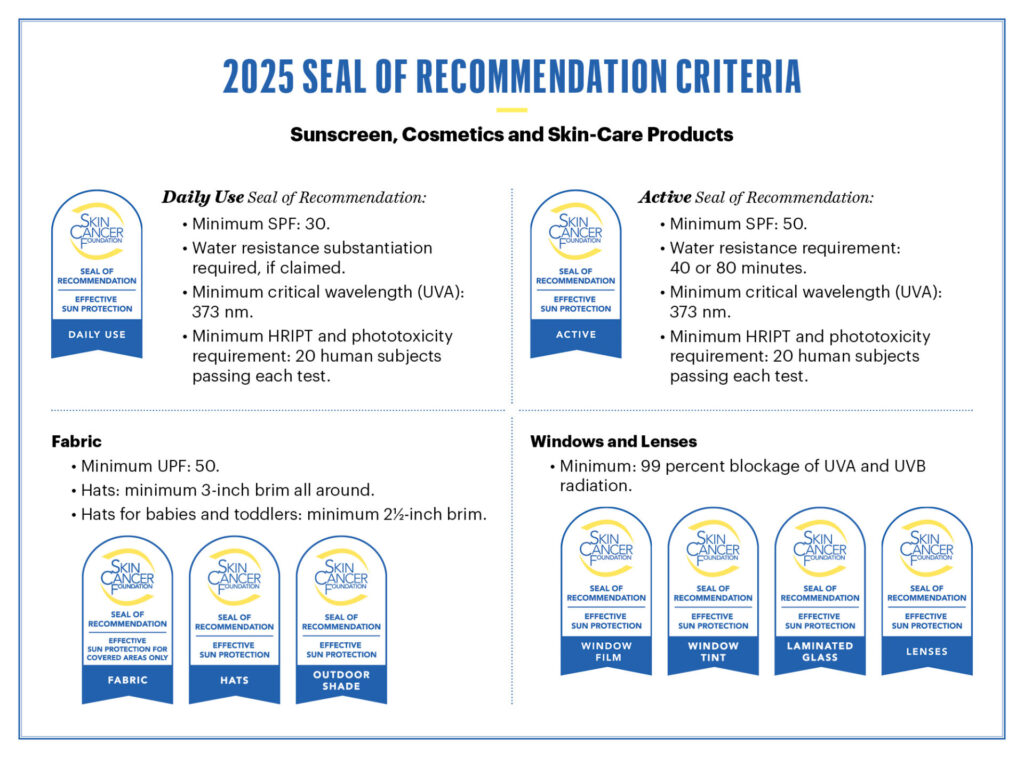
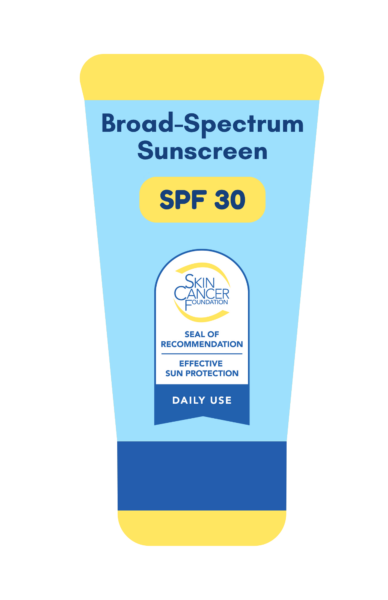
SPF 30: Ideal for every day, occasional exposure, like walking your dog, or driving to work. Look for our Daily Use Seal of Recommendation.
SPF 50 or higher: Necessary for extended outdoor activities, including distance running, hiking, swimming and outdoor sports. SPF 50 is a must if you work outdoors. Look for our Active Seal of Recommendation.
Water resistant and very water resistant: For swimming or intense exercise. No sunscreen is waterproof; they all eventually wash off. Sunscreens labeled water resistant are tested to be effective for up to 40 minutes of swimming, while very water resistant sunscreens stay effective for up to 80 minutes in the water.
When should I apply sunscreen?
Every day! The best practice is to apply 30 minutes before venturing outside to allow the sunscreen to bind to your skin. Reapply every two hours and immediately after swimming or excessive sweating.
Even when it’s cloudy, up to 80 percent of the sun’s UV radiation reaches the earth. Going unprotected on an overcast day can lead to skin damage.
Where should I apply sunscreen?
Experts recommend applying sunscreen to your entire body before you dress for the day. That way your skin will be protected if your clothing shifts or you remove layers. At the very least, you should use sunscreen on every part of your body that is exposed to the sun, including those easy-to-miss spots: the tops of your ears, back of your neck, your scalp (on the part line), tops of your feet and behind your knees.
How much sunscreen should I use?
To get the full broad-spectrum protection out of your sunscreen, apply one ounce — about a shot glass full — to your entire body. Most people apply less than half of that amount, translating into reduced protection. Learn more.
With reapplication, a family of four should use one four-ounce bottle of sunscreen per person during a long day outdoors.
Why should I use sunscreen?
Sunscreen reduces your overall UV exposure and lowers your risk of skin cancer and sun damage.
Other things to consider
- Your skin cancer risk factors: Your skin type and family history will determine the level of protection needed for you.
- Photosensitivity: No matter your skin type, certain medications and disorders make your skin highly sensitive to the sun, raising your protection requirements.
- Skin conditions: You can choose from sunscreens for dry skin, oily skin, acne-prone skin and sensitive skin.
Live a sun-safe life
Keep in mind that while crucial, sunscreen alone is not enough. Seek the shade whenever possible, wear sun-safe clothing, a wide-brimmed hat and UV-blocking sunglasses, for a complete sun safety strategy.
To help you select sun-safe products, look for the Skin Cancer Foundation’s Seal of Recommendation and browse our recommended sunscreen products.
For more prevention tips, see Your Daily Sun Protection Guide.
Reviewed by:
Elisabeth G. Richard, MD