
Is it possible to maintain a bronze glow without the dangers that come with UV tanning? We consulted with dermatologist Arielle Kauvar, MD, who provided expert insight about sunless tanning options.
The truth about tanning is startling: About 90 percent of nonmelanoma skin cancers and 86 percent of melanomas are associated with exposure to ultraviolet (UV) radiation.
Sun Safety: UV vs. Sunless Tanning
Dr. Kauvar reiterated that UV tanning is totally unsafe — it’s a significant risk factor for every type of skin cancer — and that sunless tanning should be the only option for achieving a bronzed look.
“There is no such thing as a safe UV tan,” she says. “The reddening or browning of skin with sun exposure is a sign of skin damage.”
The “tan” achieved with sunless tanners, however, is much safer than a UV tan. The active ingredient in most sunless tanners is the coloring agent DHA (dihydroxyacetone), which combines with amino acids in the skin. The resulting reaction causes browning, but unlike the reaction caused by UV rays, it involves only the outermost, dead cell layer of the skin.
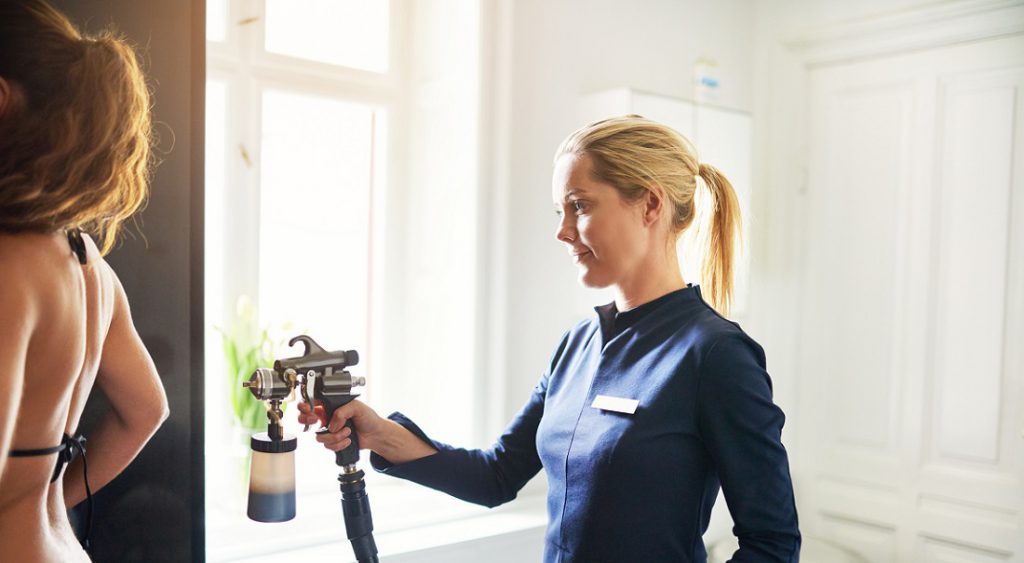
“The question of safety issues relates to spray-on tans because of the potential for inhaling the material,” Dr. Kauvar says, but adds that there is no evidence to date of any toxicity at the concentrations currently used. Still, Kauvar suggests protecting your eyes, nose and mouth as a precautionary measure while getting sprayed.
Can I Get A Quality Sunless Tan At Home?
Though getting a professional spray-tan might be preferable for a big event like a wedding, Dr. Kauvar says it’s totally possible to get an even, natural-looking tan at home. Self-tanners come in a variety of formulas, including lotions, wipes and sprays. Getting the perfect, streak-free glow takes some time and care, though.
“The key factor is making sure to exfoliate the skin well first,” Dr. Kauvar explains. “Otherwise, areas of callous or thickened, dry skin such as elbows, knees, ankles and wrists will bind more product.”
If that happens, the area will appear darker or more orange-brown than the surrounding skin. To avoid this, exfoliate thoroughly and allow your skin to dry for at least 15 minutes before applying self-tanner. Apply the product in a thin layer as evenly as you can, then wait another 15 minutes for the product to dry before putting clothes on.
“Be sure to wash your hands immediately after application,” Dr. Kauvar cautions, “or you’ll develop brown streaks on your palms.”
Those who do decide to go to a professional don’t need to worry too much about prepping for their appointment, as most application sessions will include exfoliation pretreatments.
Does This Mean I Can Skip Sunscreen?
It may be tempting to believe that your faux tan provides UV protection, but Dr. Kauvar says this definitely isn’t the case.
“Sunscreen and protective clothing should always be used in conjunction with sunless tanners,” she says. “They don’t provide adequate protection from UV rays.”
A proper sun protection regimen — whether you’re rocking your natural skin tone or a self-tanner—includes seeking shade, daily application of a broad-spectrum sunscreen with an SPF of 30 or higher and covering up with clothing, including a broad-brimmed hat and UV-blocking sunglasses. If you’re going to be out for an extended period in the sun, use an SPF 50 or higher, broad-spectrum, water-resistant sunscreen.